Why Am I Deficient Even Though I Eat Healthy? Answer
Why am I deficient even though I eat healthy? Discover the missing nutrients from modern diets and how to fix your deficiencies with the right foods today.


You had the grilled chicken. You skipped the donut in the break room. You drank the water instead of the second Coke. And at 3pm you put your head in your hand at your desk and read the same email three times.
You feel that too?
I lived on that plate for a decade. Grilled chicken, brown rice, spinach, salmon on Fridays. My wife thought I was a saint. My body thought I was starving. If you have been asking yourself why am I deficient even though I eat healthy, you are asking the right question. The answer is not more discipline.
The Word Nobody Uses: Amputated
My grandfather ate liver on Sundays. He cracked marrow bones with a spoon. He kept eggs on the counter from a chicken he knew by name. He never met a nutritionist.
I ate boneless skinless chicken breast, weighed it on a scale, and got labs back that said "normal for your age." I walked out to the truck thinking, normal for a 49 year old American man is a bar I refuse to clear.
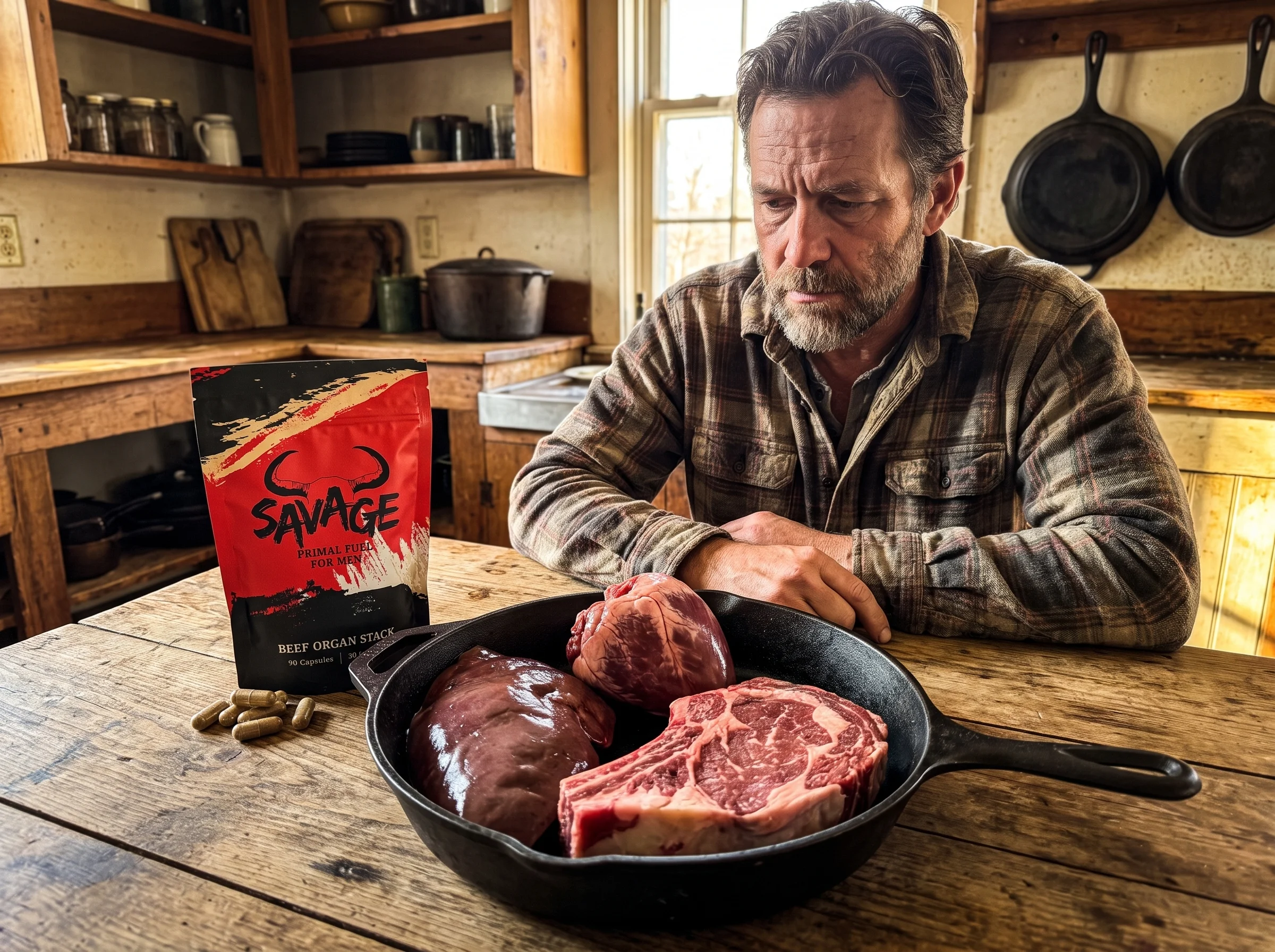
Here is the shift I wish somebody had handed me a decade earlier: modern healthy is a fragment of a food, not a food. We kept the muscle and threw away the two-thirds of the animal that actually carried the dense micronutrients. Then we called that healthy.
You would not call reading the introduction of a book "reading the book." We do exactly that with the animal every single night and act surprised by the ending.
The Label Lies to You by Accident
You read the nutrition label. You believe it. That is fair.
The problem is what is on the label is not what enters your blood. Two examples you can actually do something with.
Vitamin A from spinach and carrots is beta-carotene. Your body has to convert it to retinol, the finished product. That conversion is inefficient and varies wildly from person to person, roughly 4 to 1 up to 28 to 1 by weight [1]. Liver skips the whole exchange. It hands you the retinol directly [2].
Iron works the same way. Animal-food diets carry heme iron, and iron from mixed animal-containing diets is absorbed at roughly 14 to 18 percent in people with low stores, versus 5 to 12 percent from vegetarian diets [3].
Eating spinach for vitamin A is like paying a foreign exchange fee every time you swipe your card. Sometimes the rate is fair. Sometimes it robs you and you never see the receipt.
The Stove Is a Tax Collector
You bought good food. Then you set it on fire.
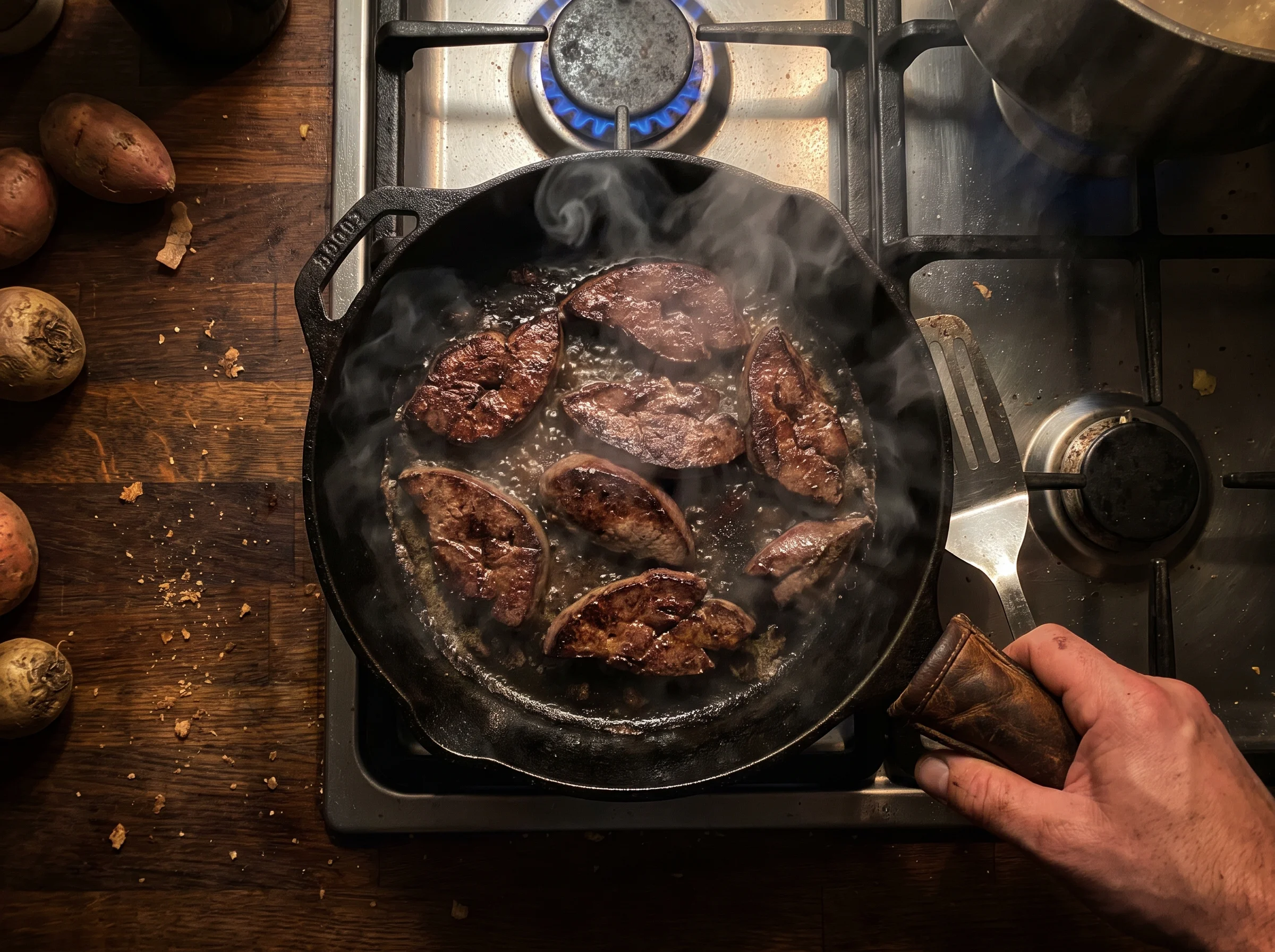
Broiling beef liver loses about 41 percent of its folate. Frying loses about 50 percent [4]. Frying beef heart cuts recoverable CoQ10 to roughly 69 percent of raw [5].
Every degree over 200 takes a cut. That is the tax.
I am not telling you to eat raw liver. Nobody with a functioning gag reflex and a job on Monday is doing that. I am telling you your "healthy" plate has already been taxed twice before your fork ever gets there, and nobody put that on the label either.
Chicken Breast Is Not a Food. It Is a Piece of a Food.
Look at what actually lives in the parts we throw away.
CoQ10, the compound that sits inside your mitochondria and helps them make ATP, concentrates in heart muscle [6]. You are not eating heart. Preformed vitamin A, B12, folate, copper, and choline concentrate in liver [2][7][8]. You are not eating liver. Selenium, which the thyroid uses, sits densely in kidney [9]. You are not eating kidney.
Choline is where this gets male-specific. Under severe choline restriction, 77 percent of men developed reversible signs of liver or muscle dysfunction, which is how researchers proved it is an essential nutrient, not an optional one [10]. Choline is concentrated in liver, roughly 330 mg per 100 grams of raw beef liver [8]. When was the last time you ate liver?
This is the braingasm nobody handed you: you have not been failing at healthy eating. You have been eating one third of the animal for thirty years and comparing yourself to men who ate the whole thing.
Why Am I Deficient Even Though I Eat Healthy? Because "Normal On Paper" Is Not the End of the Story
Your doctor said your labs looked fine. He also has three minutes per patient and a reference range built off a population that is tired, soft, and running on caffeine.
Testosterone falls gradually and progressively in healthy men with age, and the drop is documented, not imagined [11]. Sleep five hours a night for a week and daytime testosterone drops another 10 to 15 percent, at least in the young healthy men they measured [12]. Skeletal-muscle mitochondrial ATP production drops around 8 percent per decade in adults [13]. The engine that makes your energy is genuinely running slower.
The 3pm wall? Not in your head. The post-lunch dip is a documented circadian event and it happens even on days you skip lunch [14].
You are not imagining it. You are inside a normal range that stopped meaning well.

What Actually Moves the Needle
Three moves, in order. If you skip step one the others do not land.
Sleep first. Five hours in bed will out-punch anything on your plate. Poor sleep also raises baseline cortisol and blunts your stress response [15]. Fix the sleep or you are pouring water into a bucket with a hole in it.
Lift heavy and eat like a man who lifts. Testosterone acutely rises after heavy resistance work [16]. Protein target around 1.0 to 1.2 grams per kilogram per day for men over 50, more if you train [17]. No capsule ever built a shoulder. Squats and steak did.
Eat the whole animal. Not the muscle only. This is where organ meat belongs, and where I have to be honest with you: liver tastes like it lost a fight. Kidney is worse. Nobody with a family and a Tuesday meeting is pan-searing bull testicle after work.
I know because I tried. Cast iron, butter, onions, a whole ritual. I choked down three bites and poured the rest in the trash. That night I understood the food was right and the delivery mechanism was wrong.
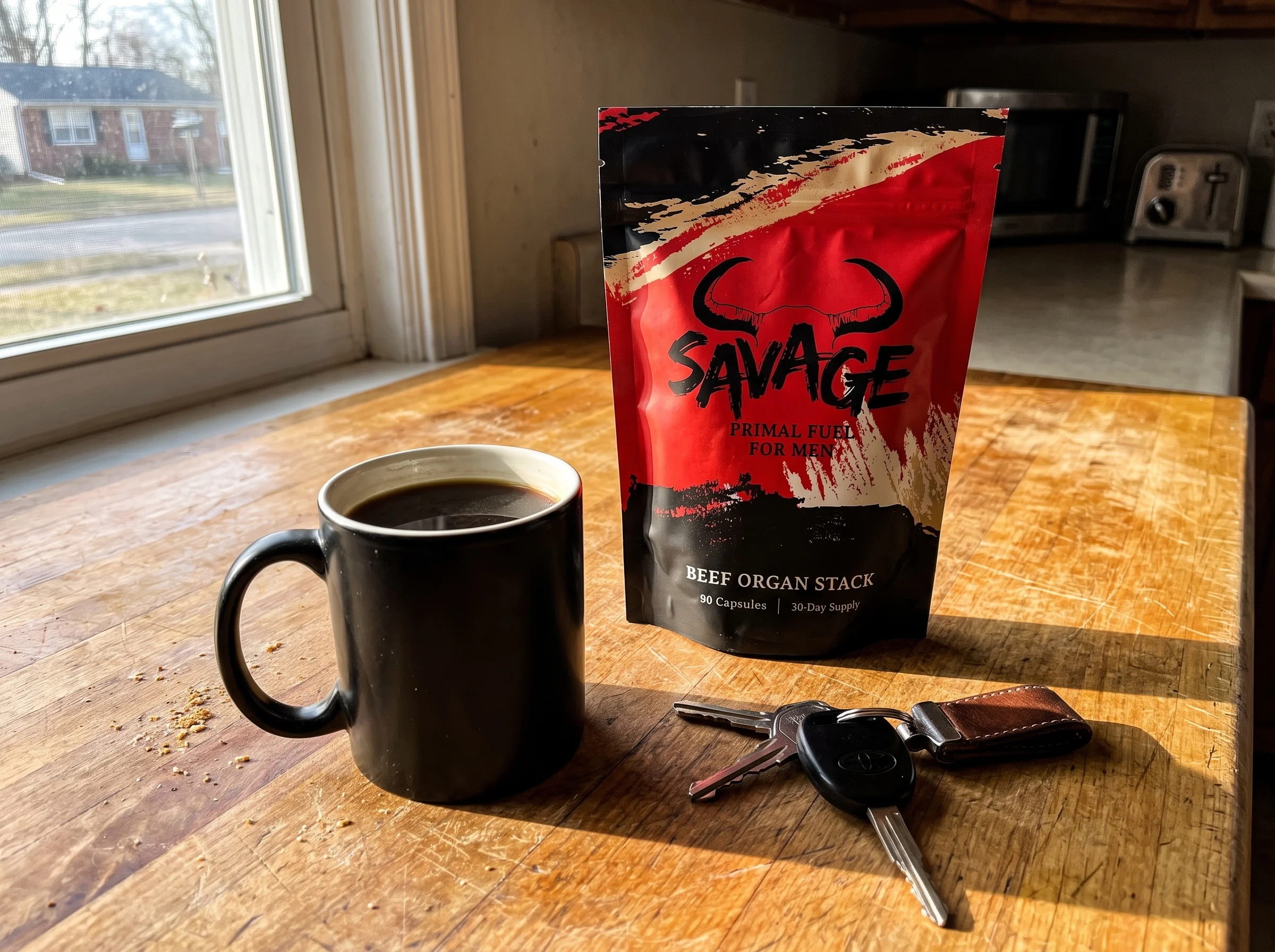
That gap, dense food that is genuinely unpleasant to eat every day, is why I take the Savage Beef Organ Stack. Three capsules with food. All six organs, liver, heart, kidney, testicle, prostate, and pituitary. Freeze-dried raw, which matters because lyophilization removes water at low temperature under vacuum and avoids the sustained heat of hot-air drying [18]. The tax I was paying at the stove never gets collected. The label says it supports testosterone production, cardiovascular health, energy, recovery, and hormonal balance, and that is the language I use because it is honest.
It does not replace the ribeye. It replaces the parts you were never going to eat.
The Point: You Eat Healthy, but You Eat a Fragment
You are not deficient because you failed. You are deficient because the definition of a healthy plate got amputated somewhere between your grandfather and you, and nobody told you.
You have been eating a fragment of a food. Cooking the tax out of what is left. Comparing your body to a population that is also tired.
You do not have to become the guy who eats raw liver in the parking lot. You just have to stop eating one third of the animal and calling it healthy.
That is the gap the Savage Beef Organ Stack fills for me and for the men I coach. Not a T-booster. Not a miracle. The missing pieces of a plate we forgot how to build.
References
[1] Tang G. Bioconversion of dietary provitamin A carotenoids to vitamin A in humans. Am J Clin Nutr. 2010;91(5):1468S-1473S. https://pubmed.ncbi.nlm.nih.gov/20200262/
[2] NIH Office of Dietary Supplements. Vitamin A and Carotenoids Fact Sheet for Health Professionals. https://ods.od.nih.gov/factsheets/VitaminA-HealthProfessional/
[3] Hurrell R, Egli I. Iron bioavailability and dietary reference values. Am J Clin Nutr. 2010;91(5):1461S-1467S. https://pubmed.ncbi.nlm.nih.gov/20200263/
[4] Aramouni FM, Godber JS. Folate losses in beef liver due to cooking and frozen storage. J Food Qual. 1991;14(5):357-365. https://onlinelibrary.wiley.com/doi/10.1111/j.1745-4557.1991.tb00077.x
[5] Ercan P, El SN. Changes in content of coenzyme Q10 in beef muscle, beef liver and beef heart with cooking and in vitro digestion. J Food Compost Anal. 2011;24(8):1136-1140. https://www.sciencedirect.com/science/article/pii/S0889157511001517
[6] Diaz-Casado ME, et al. The Paradox of Coenzyme Q10 in Aging. Nutrients. 2019;11(9):2221. https://pmc.ncbi.nlm.nih.gov/articles/PMC6770889/
[7] USDA FoodData Central. Beef, variety meats and by-products, liver, raw (169451). https://fdc.nal.usda.gov/food-details/169451/nutrients
[8] USDA Database for the Choline Content of Common Foods, Release 2 (2008). https://www.ars.usda.gov/ARSUserFiles/80400525/data/choline/choln02.pdf
[9] NIH Office of Dietary Supplements. Selenium Fact Sheet for Health Professionals. https://ods.od.nih.gov/factsheets/Selenium-HealthProfessional/
[10] Fischer LM, et al. Sex and menopausal status influence human dietary requirements for the nutrient choline. Am J Clin Nutr. 2007;85(5):1275-1285. https://pubmed.ncbi.nlm.nih.gov/17490963/
[11] Harman SM, et al. Longitudinal Effects of Aging on Serum Total and Free Testosterone Levels in Healthy Men (Baltimore Longitudinal Study of Aging). J Clin Endocrinol Metab. 2001;86(2):724-731. https://academic.oup.com/jcem/article/86/2/724/2841070
[12] Leproult R, Van Cauter E. Effect of 1 Week of Sleep Restriction on Testosterone Levels in Young Healthy Men. JAMA. 2011;305(21):2173-2174. https://jamanetwork.com/journals/jama/fullarticle/1029127
[13] Short KR, et al. Decline in skeletal muscle mitochondrial function with aging in humans. PNAS. 2005;102(15):5618-5623. https://pubmed.ncbi.nlm.nih.gov/15800038/
[14] Monk TH. The Post-Lunch Dip in Performance. Clin Sports Med. 2005;24(2):e15-e23. https://pubmed.ncbi.nlm.nih.gov/15892914/
[15] Minkel J, et al. Sleep deprivation and stressors: evidence for elevated negative affect in response to mild stressors when sleep deprived. Health Psychol. 2014;33(11):1430-1434. https://pubmed.ncbi.nlm.nih.gov/24818608/
[16] Vingren JL, et al. Testosterone Physiology in Resistance Exercise and Training. Sports Med. 2010;40(12):1037-1053. https://link.springer.com/article/10.2165/11536910-000000000-00000
[17] Bauer J, et al. Evidence-based recommendations for optimal dietary protein intake in older people (PROT-AGE). J Am Med Dir Assoc. 2013;14(8):542-559. https://pubmed.ncbi.nlm.nih.gov/23867520/
[18] Ratti C. Hot air and freeze-drying of high-value foods: a review. J Food Eng. 2001;49(4):311-319. https://www.sciencedirect.com/science/article/pii/S0260877400002284