What Should 35 Year Old Male Testosterone Be? The Truth
What should 35 year old male testosterone be? Discover the optimal range, why 'normal' isn't enough, and how to fix low T in 90 days naturally.


You logged into the patient portal, saw the number, saw the word "normal," and somehow felt worse than before the draw.
The 3pm wall is still there. The gut in the mirror is still there. The short fuse when your kid asks you the same question twice is still there. But the paper says you are fine.
Here is what nobody in that clinic told you: the number and the way you feel are not both right. One of them is lying to you. And I am going to walk you through which one, why, and what to actually do about it.
What Should a 35 Year Old Male Testosterone Be on Paper
Standard reference ranges land somewhere around 264 to 916 ng/dL, depending on which lab ran your blood. LabCorp uses that band. Others differ. Population averages for a 35 year old American man sit somewhere in the 500s.
So when your doctor sees a 480 and says "normal," he is not lying. He is reading the chart.
But "normal" is a statistics word, not a health word. It means "statistically common in the population we sampled." That is a very different sentence than "this is what a healthy man is supposed to test at."
The Baltimore Longitudinal Study of Aging showed that in healthy men, total and free testosterone fall gradually and progressively with age [1]. That is the population curve. Every reference range you see is built off populations that include men who sleep six hours, eat garbage, drink too much, sit all day, and carry twenty extra pounds around the middle.
Here is the analogy that finally cracked this open for me. Imagine a class where the average kid is failing the test. The teacher curves it. Now a 62 becomes a B. You get your B minus back, you feel okay for a second, and then you realize: you did not learn the material. You are still failing. The grade just lied about it.
That is the reference range. You are being graded on a curve made of tired, soft, foggy men. Being average in that room is not a target. It is a warning shot.

The Number That Matters More Than Total T
Here is the piece your doctor probably did not pull, and the one you need to know about.
Total testosterone is the total amount of the hormone in your blood. But a big chunk of that is bound to a protein called SHBG (sex hormone binding globulin). Bound testosterone is on the bench. It cannot do work. Only free testosterone is in the game.
You can have a total T that looks fine on paper while your free T is on the floor because SHBG climbed. And the guys who tend to have this exact pattern are the ones who are softer in the middle, sleeping badly, and running on caffeine.
Think of it like your bank account. Total T is the balance on your statement. Free T is the cash in your wallet. If your card gets declined at the counter, it does not matter how much is "in the bank."
So when you go back in, ask for the full picture:
- Total testosterone
- Free testosterone
- SHBG
- Estradiol
- LH and FSH
- Fasting insulin
- Vitamin D
- Ferritin
If your doctor pulls only total T and calls it a day, you got a snapshot with half the frame missing.
How to Not Get a Fake Number
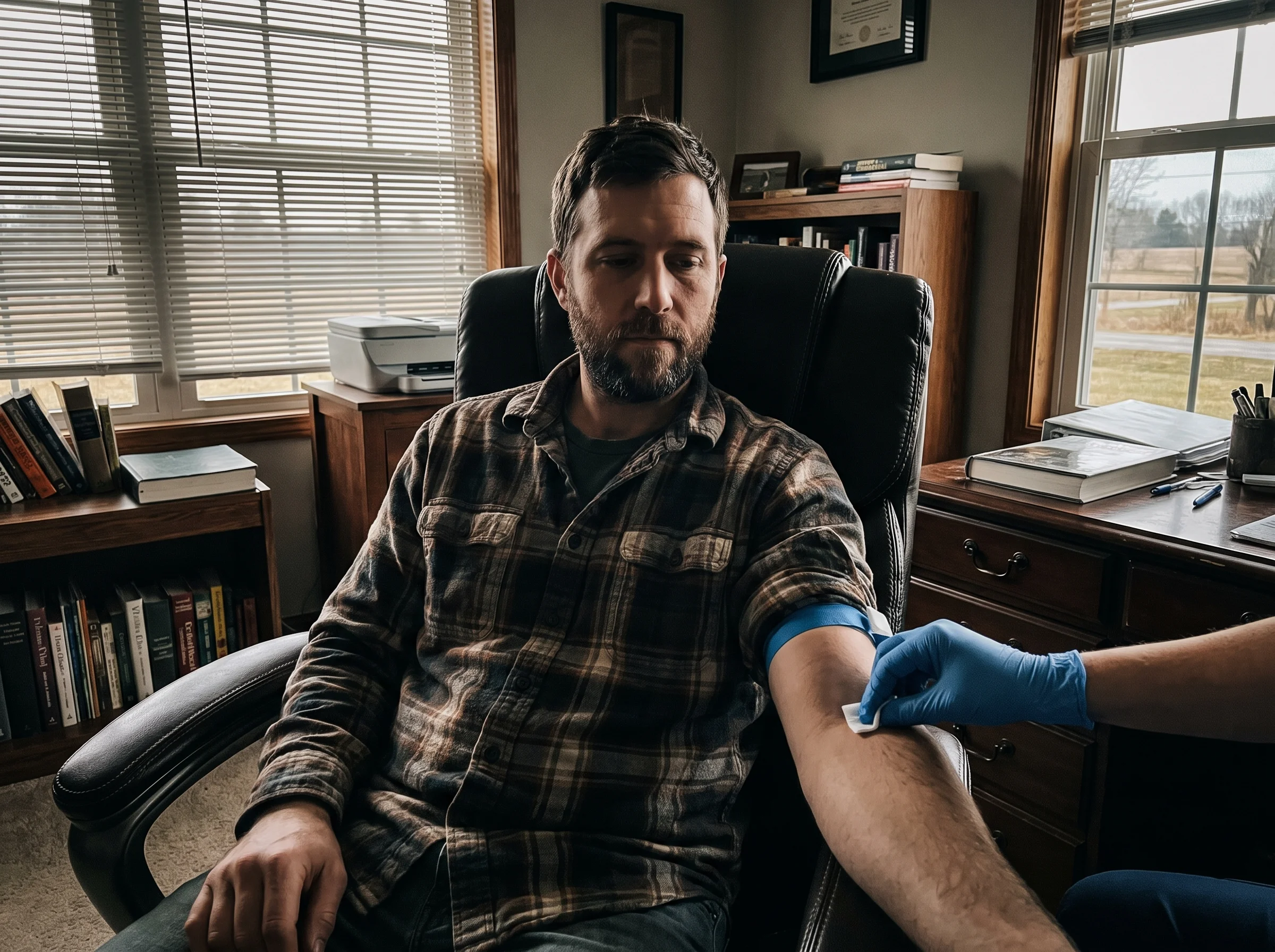
Nobody teaches you how to actually get a real measurement. Here are the rules.
Test between 7 and 10 am. Testosterone runs on a daily rhythm and peaks in the morning. A 3pm draw is not your number.
Fast. Food changes hormones. Draw before you eat.
Do not test after a bad sleep week. In healthy young men, restricting sleep to about five hours a night for a week lowered daytime testosterone by 10 to 15 percent [2]. That was young, healthy men. If it hits them that hard, you are not immune. Test after seven days of real sleep, or you are measuring the wrong problem.
Test twice, at least a couple weeks apart. One number is a moment. Two numbers are a trend. Doctors will chase a single low reading with a script. Do not let one Tuesday morning define you.
Skip the week after travel, a hangover binge, or a head cold. All of those move the number.
The Real Question Is Not "Am I Normal"
At 35, the honest question is not "am I normal." It is "which direction am I heading, and how fast."
The Baltimore data is clear that the average curve slides down over time [1]. Every man is on some version of that curve. The choice you actually get to make is whether you sit at the top of your own genetic band or the bottom of it.
That is a game you can play. The number your doctor read you is a scoreboard, not a verdict.
And by the way, that 3pm wall you keep hitting? It is not you being weak. There is a documented mid-afternoon dip in alertness that shows up even on days you skip lunch, driven by the body's circadian clock [3]. That crash is a real thing being measured in labs. You are not imagining it, and it is not a character flaw. It is physiology. Feel that click?
The Inputs That Set Your Ceiling
Before anyone talks to you about a needle, look at the inputs. Because your ceiling is set by four things, and none of them are prescription pads.
Sleep. The 10 to 15 percent hit from sleep restriction is only half the story. Sleep-deprived adults also had higher baseline cortisol and a bigger stress response [4]. Cortisol and testosterone are on opposite ends of the same seesaw. Bad sleep pushes both the wrong way at the same time.
Training. Resistance exercise acutely elevates testosterone in men, and testosterone is a major driver of muscle growth [5]. Heavy compound lifts three days a week are a hormonal signal, not just a physique play.

Protein. For healthy older or active men, expert consensus is around 1.0 to 1.2 g/kg/day minimum, with muscle gains from training plus protein plateauing near 1.6 g/kg/day [6][7]. Most guys I coach are eating half that.
Nutrient density. Cells run on specific inputs. Zinc matters for reproductive function, and deficiency causes real problems [8]. Preformed vitamin A from liver skips the conversion step that plant carotenoids have to gamble on, and that conversion varies wildly between people [9][10]. B12 runs energy metabolism at the cellular level [11]. CoQ10, the compound that sits in your mitochondria and helps make ATP, is concentrated in heart muscle for a reason and declines in some tissues with age [12]. Selenium concentrates in kidney and runs antioxidant and thyroid enzymes [13].
That is why organ meats keep coming up in ancestral eating. A 2024 analysis of raw US beef offal confirmed liver, heart, and kidney carry distinct, concentrated micronutrient loads [14]. Liver is nature's multivitamin.
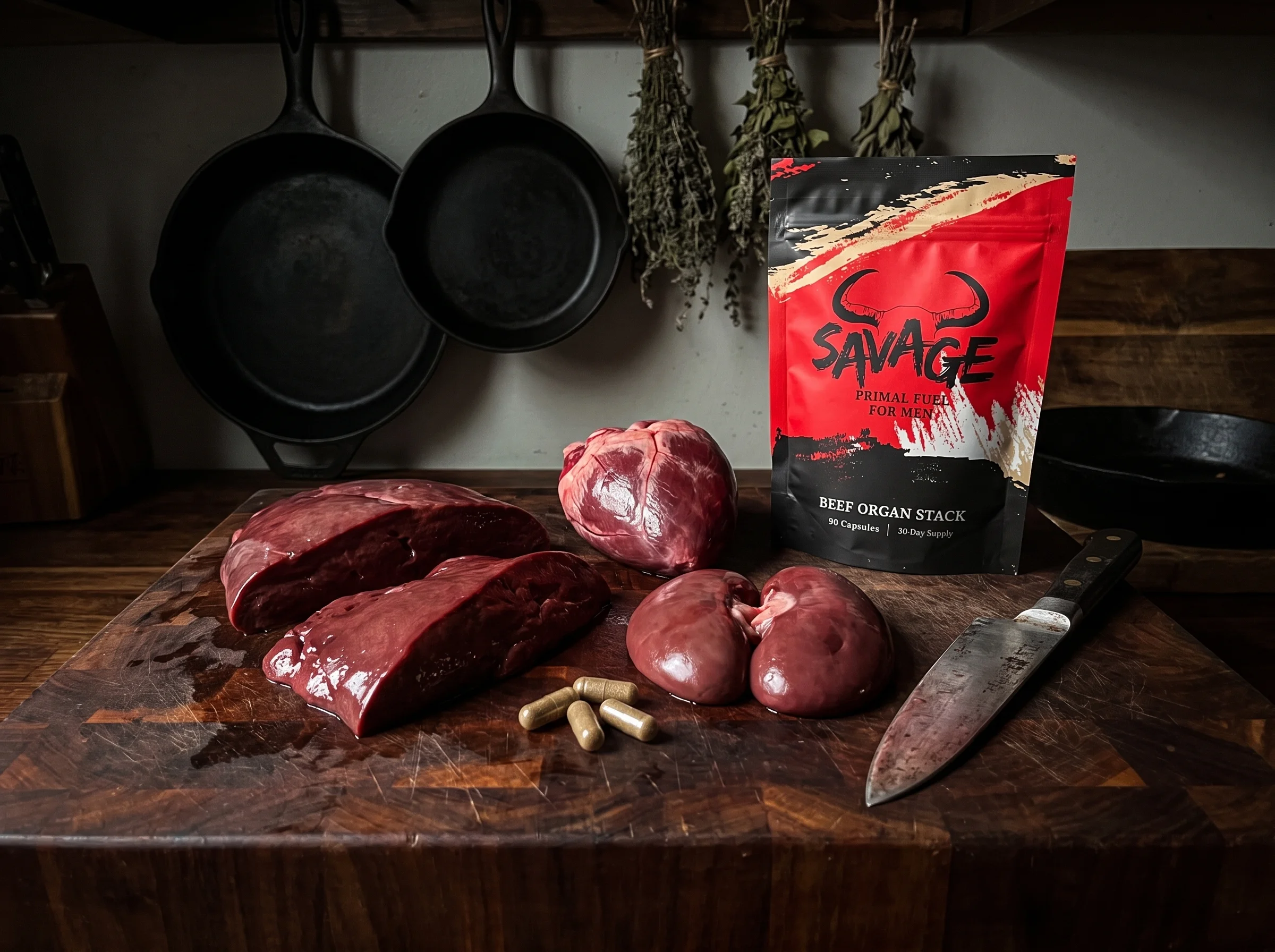
Liver also tastes like it lost a fight. There is not enough ketchup in the world to make me eat it twice a week, and I tried. That gap between "should eat organ meat" and "actually eats organ meat" is the entire reason the Savage Beef Organ Stack exists. Six freeze-dried organs, three capsules with food, no gag reflex. It supports healthy testosterone production, energy, and recovery, and it fills the input slot most guys skip because dinner is chicken breast for the fourth night in a row.

When to Push Your Doctor
If you are symptomatic and your total T comes back under 350 on two morning fasted draws, that is a real conversation, not a "come back in a year." Show up asking for the full panel, not just the number he already pulled. Ask for the SHBG. Ask for the free T calculation.
If he stonewalls, that is your answer. Get a second opinion or find a men's health specialist who actually looks at the whole picture.
You are not stuck between "just live with it" and "inject for the rest of your life." Those are the two doors most articles push you toward. There is a 90 day room between them, and most men never open the door.
The 90 Day Move Before You Draw Blood Again
Here is the plan. Run it for 90 days, then retest.
- Sleep seven hours minimum. Non-negotiable.
- Lift heavy three times a week. Compound movements. Squat, deadlift, press, row.
- Eat protein at roughly 1 gram per pound of goal bodyweight, spread across the day.
- Cut ultraprocessed food to a minimum. If it has a mascot, it is not food.
- Add nutrient-dense whole foods. Eggs, red meat, fish, and yes, organs if you can stomach them. If you cannot, the Savage stack covers that slot.
- Retest at day 90. Morning. Fasted. Two draws. Full panel.

That is the game. The number on the paper is the scoreboard. You are the player. Stop asking what the scoreboard "should" say and start playing the game that moves it.
I got told I was "normal" at 480 when I was 49. I walked out of that office feeling worse than when I walked in, because it meant the tired, foggy, soft version of me was the "healthy" version. That was the day I stopped outsourcing my body to a piece of paper.
You have 90 days. Go get them.
References
[1] Harman SM, et al. Longitudinal Effects of Aging on Serum Total and Free Testosterone Levels in Healthy Men (Baltimore Longitudinal Study of Aging). J Clin Endocrinol Metab. 2001;86(2):724-731. https://academic.oup.com/jcem/article/86/2/724/2841070
[2] Leproult R, Van Cauter E. Effect of 1 Week of Sleep Restriction on Testosterone Levels in Young Healthy Men. JAMA. 2011;305(21):2173-2174. https://jamanetwork.com/journals/jama/fullarticle/1029127
[3] Monk TH. The Post-Lunch Dip in Performance. Clin Sports Med. 2005;24(2):e15-e23. https://pubmed.ncbi.nlm.nih.gov/15892914/
[4] Minkel J, et al. Sleep Deprivation and Stressors: Evidence for Elevated Negative Affect in Response to Mild Stressors When Sleep Deprived. Health Psychol. 2014;33(11):1430-1434. https://pubmed.ncbi.nlm.nih.gov/24818608/
[5] Vingren JL, et al. Testosterone Physiology in Resistance Exercise and Training. Sports Med. 2010;40(12):1037-1053. https://link.springer.com/article/10.2165/11536910-000000000-00000
[6] Bauer J, et al. (PROT-AGE). Evidence-Based Recommendations for Optimal Dietary Protein Intake in Older People. J Am Med Dir Assoc. 2013;14(8):542-559. https://pubmed.ncbi.nlm.nih.gov/23867520/
[7] Morton RW, et al. A Systematic Review, Meta-Analysis and Meta-Regression of the Effect of Protein Supplementation on Resistance Training-Induced Gains in Muscle Mass and Strength. Br J Sports Med. 2018;52(6):376-384. https://pubmed.ncbi.nlm.nih.gov/28698222/
[8] NIH Office of Dietary Supplements, Zinc Fact Sheet for Health Professionals. https://ods.od.nih.gov/factsheets/Zinc-HealthProfessional/
[9] NIH Office of Dietary Supplements, Vitamin A and Carotenoids Fact Sheet for Health Professionals. https://ods.od.nih.gov/factsheets/VitaminA-HealthProfessional/
[10] Tang G. Bioconversion of Dietary Provitamin A Carotenoids to Vitamin A in Humans. Am J Clin Nutr. 2010;91(5):1468S-1473S. https://pubmed.ncbi.nlm.nih.gov/20200262/
[11] NIH Office of Dietary Supplements, Vitamin B12 Fact Sheet for Health Professionals. https://ods.od.nih.gov/factsheets/VitaminB12-HealthProfessional/
[12] Diaz-Casado ME, et al. The Paradox of Coenzyme Q10 in Aging. Nutrients. 2019;11(9):2221. https://pmc.ncbi.nlm.nih.gov/articles/PMC6770889/
[13] NIH Office of Dietary Supplements, Selenium Fact Sheet for Health Professionals. https://ods.od.nih.gov/factsheets/Selenium-HealthProfessional/
[14] Fuerniss HF, et al. Nutrient Analysis of Raw United States Beef Offal Items. Nutrients. 2024;16(18):3104. https://pubmed.ncbi.nlm.nih.gov/39339704/