What Are the 10 Signs of Low Vitamin D? A Man's Guide
What are the 10 signs of low vitamin D? The tired, foggy, achey stuff you've been blaming on turning 50 might be one lab number your doctor called fine.


The 6:47am moment that made me pay attention
It's 6:47am. You are sitting on the edge of the bed. Your lower back aches for no reason you can name. You already feel tired, and you have not stood up yet. You are staring at the same patch of carpet you stared at yesterday, trying to remember the last morning you actually wanted to be awake.
You have been telling yourself this is fifty. It's the kids. It's the weather. It's a rough quarter at work. It's been a rough year in general.
What if a chunk of what you are blaming on age is one number on a lab your doctor already ran and told you was fine?
That was me at 49. I spent a full year chasing what I thought was low T. Foggy, flat, catching every cold my kids brought home, lifts stalled, mood dimmer than I liked to admit. Then a guy smarter than me asked one question. When was the last time you checked your vitamin D? I hadn't. Turned out I was at 22 ng/mL. My doctor called it "within range." I felt like a bag of wet sand.
That number changed how I think about this whole conversation. So let me walk you through it the way I wish someone had walked me.
Vitamin D is not a vitamin. It's a hormone.
Here is the piece nobody tells you clearly.
Your body makes vitamin D from sunlight on skin, and then it treats what you make like a signaling molecule. Vitamin D receptors sit in muscle tissue, in immune cells, in the gut, in the brain, in the testes. Almost every system in your body has a place to plug it in.
That is why the "10 signs of low vitamin D" list you see everywhere reads like a horoscope. All of it applies. Tired, moody, weak, sick, achey, soft. Because when a hormone-like signal drops across every system at once, every system runs a little quieter. It is one signal turned down, and ten places where you can hear the silence.
That's the aha. Once you see D as a hormone instead of a vitamin, the rest of this article stops feeling like a checklist.
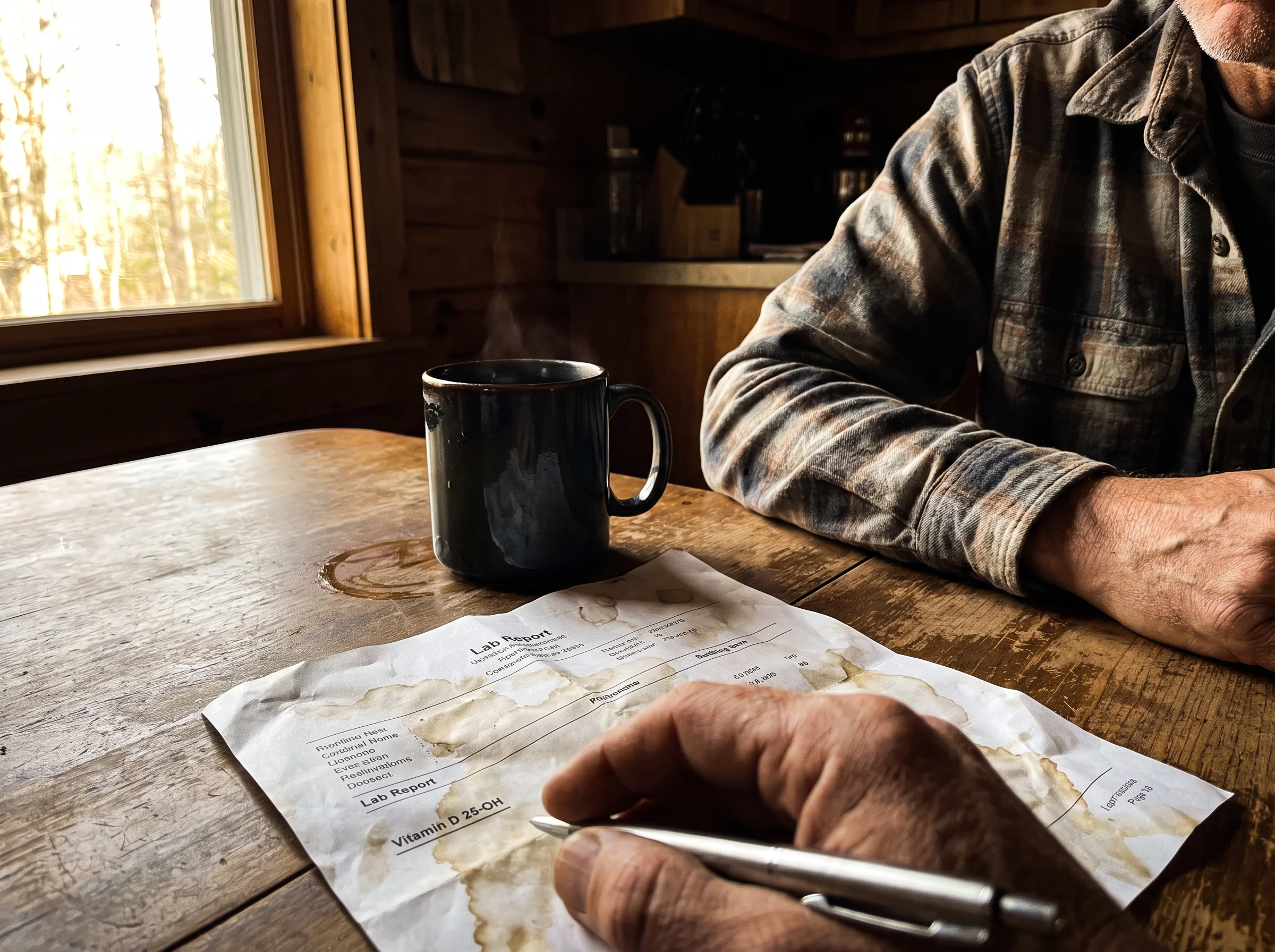
The 10 signs of low vitamin D, and what each one actually means
Every article ranking for this query gives you a bulleted list with no "why." That's useless. Here is what a middle-aged man actually feels, and what is happening underneath.
1. You are tired even after a full night's sleep. Your cells build ATP (the energy currency) in the mitochondria, and that machinery already slows measurably with age [1]. Add a hormone signal running low across the whole system and the tank never fills.
2. You catch every cold your kids drag through the door. Immune cells carry vitamin D receptors. When the signal is dim, they respond slower.
3. Your mood is flatter than it used to be. D is active in brain regions involved in mood regulation. Not a diagnosis, not a treatment claim. Just a place where the receptor is present.
4. Your lifts stalled, or worse, went backwards. Muscle fibers have D receptors too. Weak grip and slow recovery show up in men with low levels.
5. Bones and joints ache for no clear reason. D governs how your body handles calcium and remodels bone. The dull ache in your hips and lower back at 6:47am often lives here.
6. Your hair is thinning faster than your dad's ever did. Hair follicles carry the receptor. Enough said.
7. Cuts and bruises take forever to close. D plays a role in skin repair and inflammation control. That paper cut from Tuesday should not still be there Saturday.
8. You are softer in the middle even though nothing changed with food. Low D is associated with insulin resistance and belly-first fat storage patterns. The mirror is not lying.
9. Your drive is dimmer, in every sense. D receptors sit in the testes and hypothalamus, right in the middle of the hormonal cascade you are Googling as "low T." I am not saying D fixes T. I am saying the same signal is quiet in both places.
10. Winter hits harder than it used to. Fewer UVB days means less sunlight-to-skin conversion. If you noticed a step down every October, that is not in your head.
Now look at that list again. How much of it were you privately blaming on turning fifty?
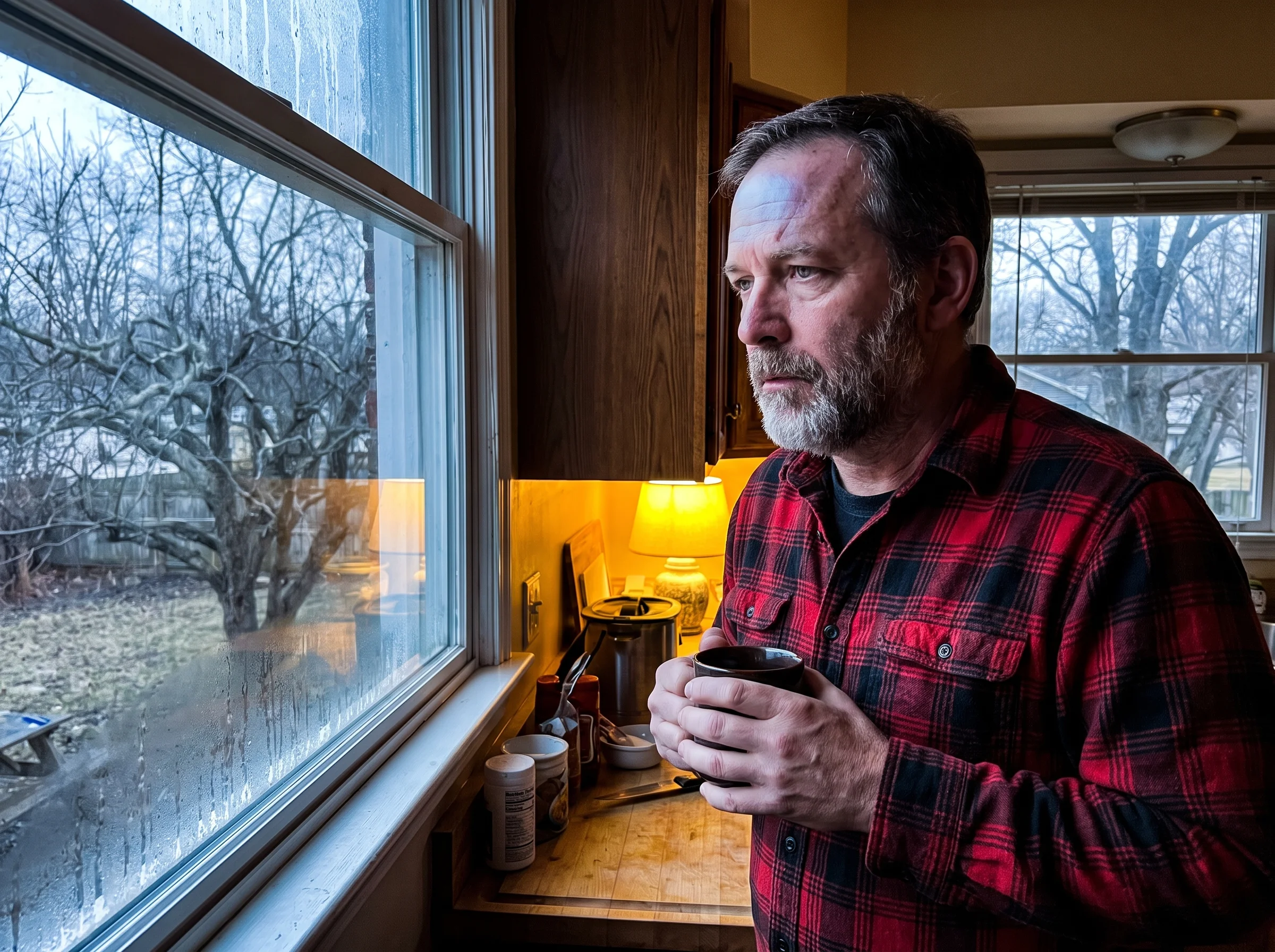
Why your labs said "normal" and you still feel like garbage
Here is the trap that kept me stuck for a year.
The reference range on your lab report is not built to tell you when you are thriving. It is built to tell you when you have crossed the line into clinical deficiency. Above 20 or 30 ng/mL, most reports slap "sufficient" on the page and move on.
Sufficient for what, exactly?
Sufficient to keep your bones from cracking is not the same thing as sufficient to feel like the man you were at 35. Passing a driving test with one eye closed is technically legal. It is not what you want when you are merging onto a highway at 75 miles per hour with your kids in the back seat.
Most of the functional practitioners I trust want to see men in the 50 to 70 ng/mL range before they say the tank is full. I am not diagnosing you. I am telling you that "normal on paper, feels like hell in real life" is a real gap, and vitamin D lives right in the middle of it. Get the actual number. Not the word "normal." The number.
Why you're deficient in the first place
This is the part almost every article skips.
Modern life is indoors. You wake up in a dark bedroom, drive to work in a metal box, sit under fluorescent lights for nine hours, drive home in the dark, and then sit on the couch. Even on the days you are outside, it is usually before or after the sun is high enough to trigger real UVB conversion in your skin. Your grandfather worked outside. You do not.
The food piece is one nobody talks about. Vitamin D does not work alone. It has fat-soluble partners, vitamin A and the vitamin K2 family, that determine whether the D you make or swallow actually gets used properly in the body. Vitamin A is involved in cellular communication, immune function, and reproduction [2], and the preformed retinol form your body can use directly is concentrated in liver. Plants give you beta-carotene, which your gut has to convert to retinol at a wildly variable rate that can run anywhere from about four-to-one to twenty-eight-to-one by weight [3]. In other words, your salad is a gamble. Your grandfather's liver and onions was not.
And here is the kicker. Muscle meat, the ribeye and the chicken breast that make up ninety percent of what modern men actually eat, carries almost none of the fat-soluble players. Your grandfather ate the whole animal because he could not afford to throw the rest away. You eat the steak and the butcher takes the good stuff home.
That is the gap. That is why you can eat "healthy" and still be running on fumes.
What actually moves the needle
Three things, in order of impact.
Sun on skin whenever you can steal it. Free, ancient, the way your body was built to make this stuff. Ten to twenty minutes of arms and face at midday on the days you can get it beats any capsule.
Whole-food fat-soluble vitamins. Liver, egg yolks, fatty fish. This is where D's partners live. Preformed vitamin A from liver skips the conversion gamble your body has to play with plant sources [3]. Your body recognizes this food. It has for two hundred thousand years.
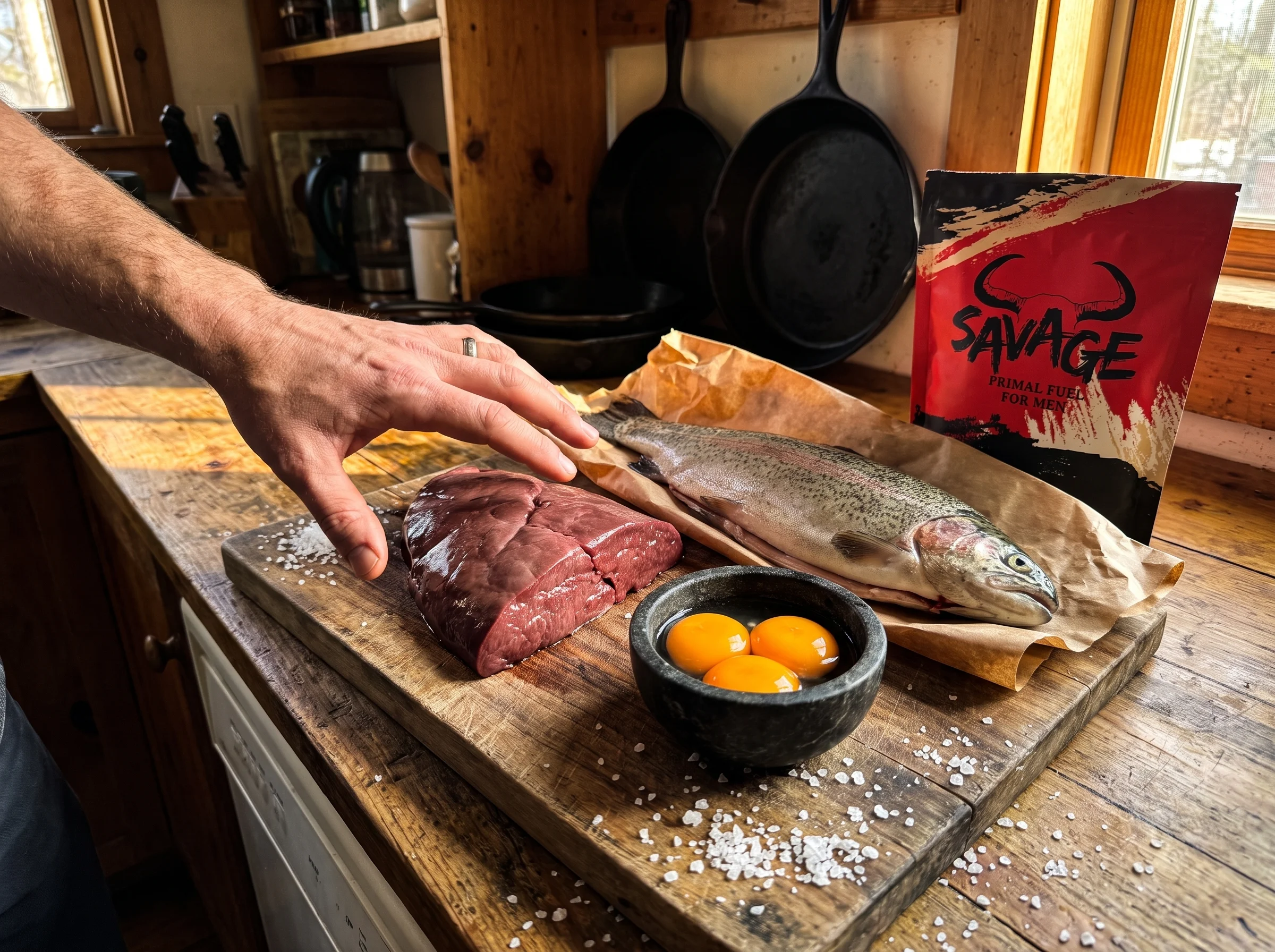
Supplement D3 in winter, and handle the cofactors. Do not just chug D3 in isolation. Magnesium is required for the conversion steps. K2 helps direct calcium where it belongs. Chugging D3 alone is like filling the gas tank and forgetting the oil.
Here is where I am honest with you.
I tried to eat liver every week. I really did. There is not enough hot sauce, onion, and bacon in the world to make a piece of liver taste like something I want at 6am. Neither can most of the men I coach. That is the whole reason the Savage Beef Organ Stack is in my routine. Three capsules with breakfast, six organs (liver, heart, kidney, testicle, prostate, pituitary), freeze-dried raw so the fragile stuff is not cooked to death. It is not a D pill and it is not a T pill. It is the fat-soluble partner food your ribeye does not carry. It is what my grandfather ate and I would not.
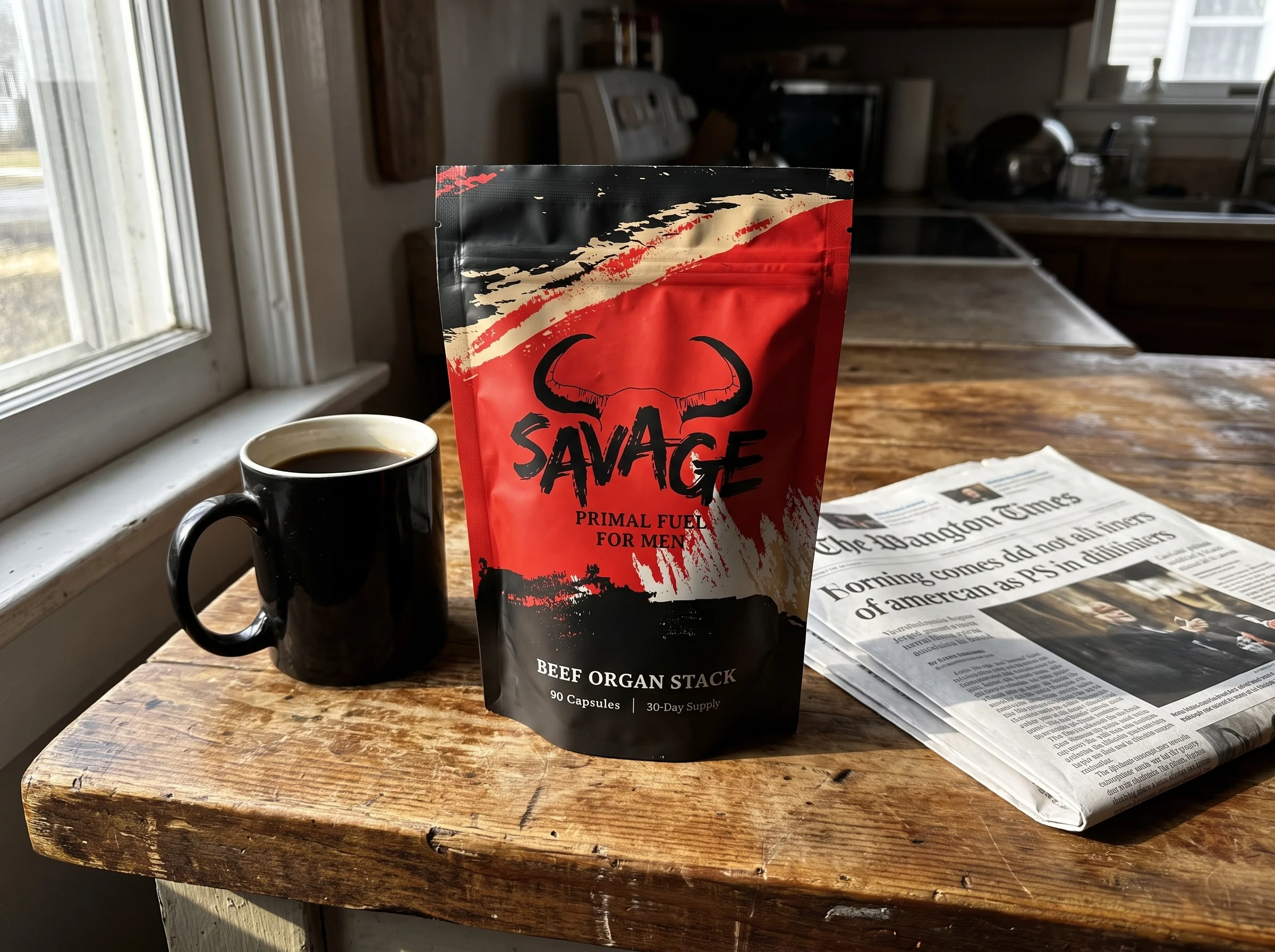
What it actually felt like when I fixed it
I want to be careful here because I am not going to sell you a fairy tale.
The energy came back first. Not the fake caffeine buzz. The real thing, where you notice the 3pm wall got quieter without you thinking about it. Mood came back second. My fuse got longer. My wife noticed before I did. The gym came third and it was the slowest. Weeks, not days.
I also stopped getting sick as often. Anecdotal. Yours might be different. I am telling you what happened to me.
None of it happened because of one pill. It happened because I got the D checked and handled, I got outside on purpose, I started sleeping seven hours instead of five, and I fed my body the raw material it recognized. Sleep matters more than any supplement, by the way. Sleep-deprived adults show higher baseline cortisol and a bigger stress response to whatever the day throws at them [4]. No capsule fixes a five-hour night.
I stopped feeling like a passenger in my own body. That is the sentence I keep coming back to.

The one takeaway
Those ten signs at the top of this article are not future warnings. They are present pain, happening to you right now, and you have been swallowing them as the tax of getting older.
Vitamin D is a hormone, "normal" is a floor and not a target, and you are almost certainly short on the food-based partners that make D work. That is different from another T-booster you saw on Instagram. It is different from another energy pill. It is the raw material your body recognizes as food, in the parts of the animal you stopped eating.
Your one next step this week: get your vitamin D level pulled. Ask for the actual number, not the word "normal." Then start eating (or supplementing with) the fat-soluble partners your muscle meat does not carry. That is the lever you did not know you had.
You do not have to accept 6:47am.
References
[1] Short KR, et al. Decline in skeletal muscle mitochondrial function with aging in humans. PNAS. 2005;102(15):5618-5623. https://pubmed.ncbi.nlm.nih.gov/15800038/
[2] NIH Office of Dietary Supplements, Vitamin A and Carotenoids Fact Sheet for Health Professionals. https://ods.od.nih.gov/factsheets/VitaminA-HealthProfessional/
[3] Tang G. Bioconversion of dietary provitamin A carotenoids to vitamin A in humans. Am J Clin Nutr. 2010;91(5):1468S-1473S. https://pubmed.ncbi.nlm.nih.gov/20200262/
[4] Minkel J, et al. Sleep deprivation and stressor-evoked changes in cortisol. Health Psychol. 2014;33(11):1430-1434. https://pubmed.ncbi.nlm.nih.gov/24818608/